There’s a number most traders don’t fully process. Somewhere around 2-3% of funded traders stay profitable long term, meaning they’re still funded, still active, and still net positive six months or more after getting there. Not challenge buyers. Not people who passed once. Funded traders who actually held on.
Most people assume the hard part is passing the evaluation. It’s not. The real test starts the day you get funded.
The Data Backs This Up More Than You’d Think
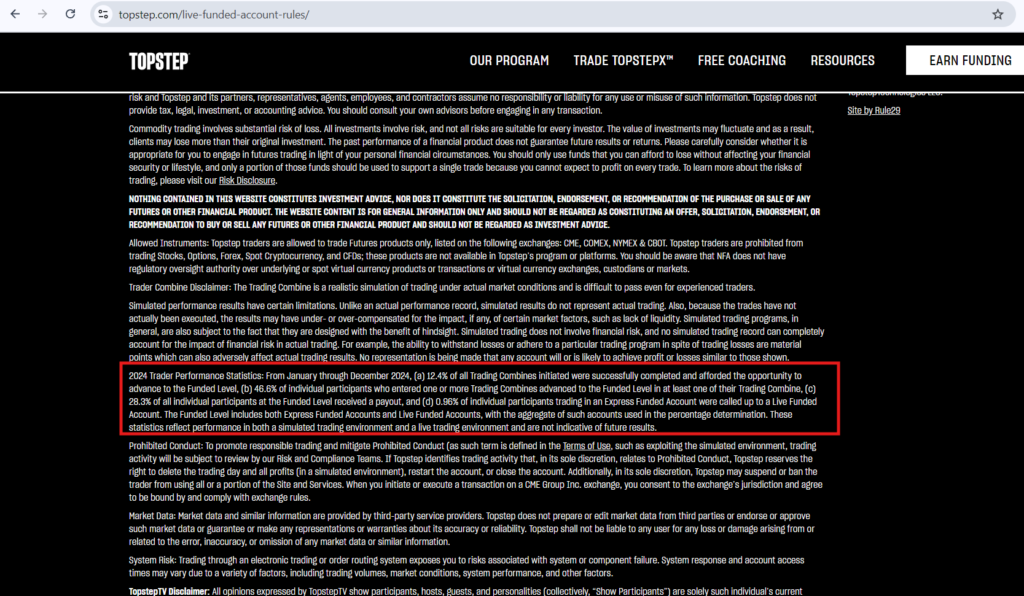
Most firms don’t publish numbers like this. Topstep does, and their own stats tell the story better than any estimate could.
In 2024, 12.4% of all Trading Combines that traders started were completed successfully enough to reach the Funded Level. Of the people who tried at least one Combine, 46.6% made it to Funded status at some point. Of everyone sitting at the Funded Level, only 28.3% ever received a payout. And of Express Funded traders specifically, just 0.96% got called up to an actual Live Funded Account.
2025 improved slightly on paper. 16.8% of Combines were completed, 51.8% of participants reached Funded status at least once, and 33.3% of funded traders got a payout. But the number that actually matters, the call-up rate to a real live account, dropped to 0.71%. More people are passing. Fewer are making it all the way to real capital.
Read those numbers again. Even at a firm that’s genuinely transparent about it, less than a third of the people sitting at the Funded Level ever see a single payout. That’s not a small-sample fluke. That’s two full years of data from one of the biggest names in the space.
Passing Proves One Thing. Surviving Proves Another
Passing an evaluation proves you can hit a profit target inside a rule set. That’s it. It doesn’t prove you can manage capital calmly for months, sit through a drawdown without panicking, or actually cut your risk when the setup calls for it.
What firms watch for once you’re funded isn’t flashy. It’s drawdown control, consistency, and whether you follow the rules when nobody’s forcing you to. Evaluation rewards short-term execution. Funded trading rewards long-term discipline. Those are two different skills, and passing one doesn’t automatically hand you the other.
The First 90 Days Are Where Most Accounts Die
The first three months after funding are brutal, and almost nobody talks about why.
You just spent weeks, sometimes months, grinding through an evaluation. You finally get funded and the confidence hits different. Risk creeps up. You feel like you’ve earned the right to trade bigger. And here’s the part that trips people up: the aggressive approach that got you through the evaluation is not the same approach that keeps you funded, especially when it’s your only account and there’s nothing to fall back on if it goes wrong.
Then the first real drawdown shows up. After everything it took to get here, that drawdown doesn’t feel like a normal part of trading. It feels personal. And that frustration is exactly when people stop trading their plan and start trying to force their way back to green.
That’s when breaches happen. Not because the strategy stopped working. Because the person behind it stopped trading like themselves.
The Pattern Nobody Wants to Admit
You’ve probably seen this exact story on Reddit, because it comes up constantly. Someone spends months clearing a combine, finally gets funded, and blows the whole account in minutes after one bad trade spirals. Or someone passes clean, funded within days, then breaches the account almost immediately once real pressure sets in. These aren’t rare posts. They’re a genre at this point, and if you’ve traded funded accounts for any length of time, some part of this probably feels a little too familiar.
The traders who don’t last tend to do a few things without even realizing it:
- Keep sizing the same way they did during evaluation, or bigger
- Increase risk right after a payout instead of protecting it
- Trade more often than their actual setup calls for
- Never mentally shift gears once real capital is on the line
None of this is a strategy problem. It’s a business problem. A funded account is capital someone else is trusting you with, and it needs to be treated like a business you’re trying to keep running, not a lottery ticket you’re trying to cash before it expires.
Overtrading Is the Real Killer
A lot of traders feel like they have to always be in something. Chasing every small intraday move, trying to call every little swing. On very short timeframes, a lot of that price action is closer to noise than signal.
The traders who actually last tend to trade less, not more. They wait for conditions that actually fit their setup instead of forcing trades to feel productive. And when a drawdown does show up, especially after a long evaluation grind, they don’t treat it as a crisis. They treat it as a Tuesday.
Controlled equity swings are sustainable. Emotional ones aren’t. And overtrading after a rough stretch is usually the fastest way to turn a manageable drawdown into a blown account.
The Bottom Line
Nobody stays funded long term because of some hidden indicator or secret setup. It comes down to behavior, full stop.
Topstep’s own numbers make it clear: getting funded is the easy part compared to what comes after. Most traders can pass an evaluation if they grind long enough. Very few can protect capital, dial back risk instead of increasing it, and keep trading the same account with the same discipline six months in as they did on day one.
Passing gets you funded. Discipline is the only thing that keeps you there.

About the Author